
Côte d'Ivoire
Read more
Between 2014 and 2019, the Islamic State in Iraq and the Levant (ISIL, Islamic State or Da’esh) declared its caliphate over large parts of Iraq and Syria. ISIL’s rule was characterised by brutality and the group is alleged to have committed, among other crimes, genocide, murder, enslavement, sexual violence, torture and forced displacement. Christians, Yazidis, Turkmens, Sabea-Mandeans, Kaka’e, Kurds, Shabak, Shias, and Sunnis perceived to be affiliated with the Iraqi Government were among those targeted and subjected to systematic killings, abductions, pillage and the destruction of their property. Women belonging to some of these minorities, were especially targeted by the ISIL regime which ran an organised system of trafficking and enslavement of women and girls. Held as slaves or sabāyā (female prisoners of war), women were photographed and catalogued to be bought, traded or gifted. Often kept in the homes of fighters, they were regularly subjected to inhumane treatment and sexual and gender based violence.
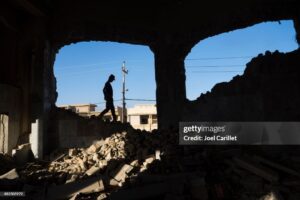
Mosul, Iraq – May 24, 2017: An Iraqi man walks in the rubble of the heavily damaged Church of St. Ephraim, a Syriac Orthodox church in Mosul, months after this part of Mosul was taken from ISIS.
Iraq, has also suffered from the highest rates of enforced disapearances in the world. A UN report prepared by the Committee on Enforced Disappearances estimated that between 250,000 and 1,000,000 individuals have been disappeared since 1968 due to conflict and political violence. The report analysed the waves of dissappearances, and linked them to the Baath Era under Saddam Hussein (1968-2003), the 2003 invasion and subsequent US occupation, the proclemation of the Islamic calephate by ISIL, and the 2018-2020 government protests. Perpetrators include state security agents, foreign military, and militias.
Despite the immense scale of violations, very few perpetrators have been held to account. In relation to ISIL crimes, some fighters have indeed been put on trial in European jurisdictions. However, many of these prosecutions have focused on terrorist crimes and individuals have not been prosecuted for the war crimes, crimes against humanity and acts of genocide that they committed during their membership in the terrorist organisation. Justice avenues within Iraq also remain very limited for survivors. The closure of UNITAD, the United Nations investigative mission in Iraq, left an urgent need to consider alternate avenues for accountability for victims of crimes perpetrated by ISIL. While it was hoped that UNITAD’s investigations would lead to the building of dossiers to assist prosecutions in various States, the closure of their mission and the current lack of clarity about what will happen to their archive leaves a huge gap in the accountability landscape.
Civitas Maxima is working with key partners, including local organisations, and local communities both in Iraq and in the diaspora to build cases against perpetrators that reflect the full criminality of their actions and address the scope of harms suffered by survivors.
Civitas Maxima can help victims to navigate justice processes. If you would like to share information or contact us for assistance, please use the following email address: [email protected], or Whatsapp us on +41 783166324.
Read more
Read more
Read more
Geneva/Sinjar, 24 June 2026 – Yazda and Civitas Maxima signed a Memorandum of Understanding (MoU), formalizing their cooperation to advance accountability for international crimes committed by the Islamic State of Iraq and the Levant (ISIL).
Subscribe to our newsletter and stay informed about Civitas Maxima's latest news.