
If President Donald Trump so dearly wishes to receive the Nobel Peace Prize awarded before him to Theodore Roosevelt, Woodrow Wilson, Jimmy Carter and Barack Obama, the Norwegian Committee could not have signalled more clearly that he will never get it than through this year’s choice of laureate, South Africa’s Navi Pillay. A lawyer in her own country and at the forefront of the fight against racial discrimination, she went on to devote 30 years to the enforcement of international law.
The American response, a few hours later, shows the scale of the affront: the announcement of sweeping economic sanctions to come against the International Criminal Court (ICC) as a whole, an open attempt to strangle an international institution to which nearly two thirds of the world’s states still belong. This announcement crowns years of hostility towards a court that took on one of Washington’s closest allies when it issued an arrest warrant in 2024 against the Israeli Prime Minister. And yet, the Americans built this body of international criminal law over more than 80 years.
Nuremberg, the American legacy
At the end of the Second World War, there was no consensus on putting the most senior Nazi leaders on trial. Winston Churchill, for one, was rather inclined to put a bullet in their heads. It was American determination, and then the leadership of American prosecutors, that gave the Nuremberg trial and some of the trials that followed such importance for the development of international criminal law, establishing the founding principle that individuals, and not only states, can be held criminally responsible for international crimes.
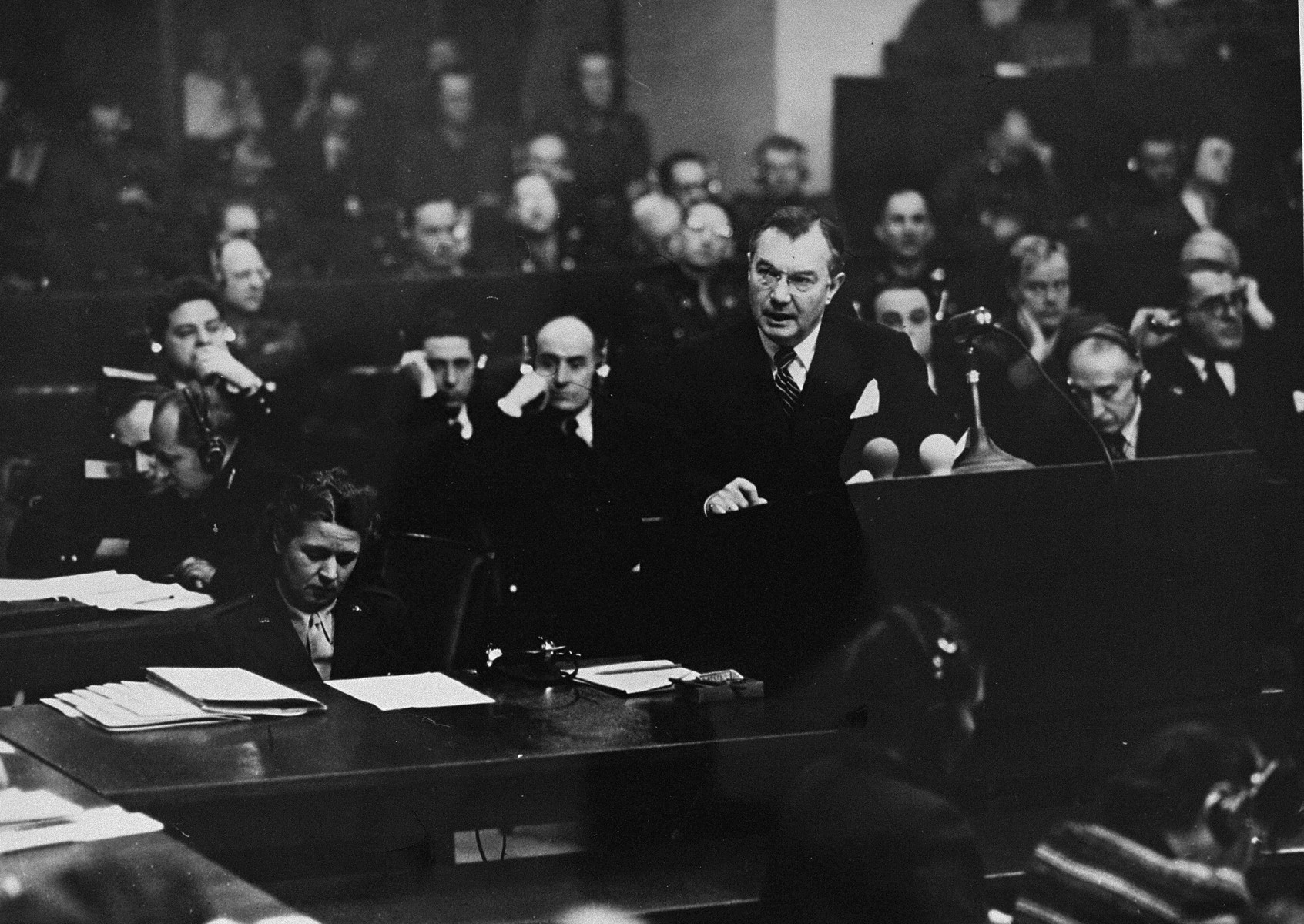
American lawyers left their mark on this period, first and foremost the prosecutor Robert Jackson, whose opening address at Nuremberg entered history, notably with these words: “That four great nations, flushed with victory and stung with injury, stay the hand of vengeance and voluntarily submit their captive enemies to the judgment of the law is one of the most significant tributes that Power has ever paid to Reason.” The American judge Francis Biddle and his compatriots, the prosecutors Telford Taylor and Benjamin Ferencz, as well as Murray C. Bernays, architect of the prosecution plan, also left their mark on these trials.
The tribunals of the 1990s and 2000s
The Cold War then “froze” this body of law for more than 40 years. It took off again in the 1990s and 2000s thanks to the United Nations, with funding from the United States among others, through the ad hoc and hybrid tribunals: the former Yugoslavia, Rwanda, Sierra Leone, Cambodia, East Timor, Kosovo and Lebanon. Here again, American judges and prosecutors played a decisive role in developing the case law of these tribunals, including the prosecutors Brenda Hollis, Nicholas Koumjian, Stephen Rapp, Mark Harmon, Alan Tieger, Jack Smith, Alex Whiting and Christopher Santora, and the judges Gabrielle McDonald, Patricia Wald and Theodor Meron. Not forgetting the lawyer Reed Brody, the driving force behind the Hissène Habré case. Several of them are still active today.
The turning point of 2002
At the time, Washington showed no hostility towards these tribunals. That hostility emerged with the negotiations leading to the Rome Statute and the creation of the ICC, then took on a new dimension with the 11 September attacks, the “war on terror” in Afghanistan and then Iraq, and the start of the ICC’s work in 2002. Bill Clinton had signed the Rome Statute in December 2000, but the administration of George W. Bush withdrew that signature in May 2002.
That same year, Congress passed the American Service Members’ Protection Act, signed into law by President George W. Bush. It imposed a general ban on cooperating with the ICC, restricted military aid to states parties to the ICC, and authorised the US president to use “all means necessary and appropriate” to secure the release of American or allied nationals detained or imprisoned by the ICC. Hence the nickname some gave the law: “The Hague Invasion Act”.
Guantánamo, the counter model
2002 was also the year the first detainees arrived at the Guantánamo counterterrorism prison, which has since become the ultimate symbol of a fight against terrorism waged in flagrant violation of fundamental rights. Detained for 24 years, four of them in secret CIA sites, Abd al-Rahim al-Nashiri, accused in particular of taking part in the 2000 attack on the USS Cole (in which 17 sailors were killed), has still not been tried. His trial is due to begin on 26 October with jury selection and will continue into 2027. He faces the death penalty.
Mr al-Nashiri was also the very first defendant in a capital case to obtain a ruling from a judge that his confessions could not be used at his trial, setting an important precedent. Since then, US military judges have excluded other confessions obtained at Guantánamo because of the circumstances in which they were extracted, for a total of five detainees facing the death penalty.
Ever broader sanctions
Since 2002, Washington’s opposition in principle to the ICC has never wavered, but it changed in scale under Donald Trump. In 2020, the first economic sanctions targeted the then Prosecutor, Fatou Bensouda, and a member of her team over the ICC’s investigations in Afghanistan. Joe Biden lifted those sanctions in 2021.
Then, from February 2025 to August 2026, new economic sanctions hit nine judges, including the Japanese judge Tomoko Akane, President of the ICC, and four prosecutors, including Karim Khan, then Chief Prosecutor. They followed in particular the 2024 arrest warrants targeting Benjamin Netanyahu. These attacks culminated on 9 October 2026 with the announcement of economic sanctions against the entire ICC, with Marco Rubio threatening to dismantle the court “brick by brick”.
We must not allow the International Criminal Court to be destroyed
The US administration will not succeed in destroying a body of law that, over several decades, owed so much to the contribution of its own judges and prosecutors. Indeed, to a very large extent, international criminal law now lives in national courts, far more than at the ICC.
But today, the ICC is fighting for its survival under a barrage of American economic bombs. It must be defended with strength and conviction, in Bern, in Brussels and everywhere else.
The article first appeared in French in Le Temps on October 26, 2026
Photo: US Chief Prosecutor Robert H. Jackson at the Nuremberg trial, 1945–1946. U.S. Army / Wikimedia Commons