
In recent weeks we have witnessed two major events linked to justice for international crimes committed in the former Yugoslavia: the death in detention of the former Bosnian Serb military commander Ratko Mladić, convicted of genocide among other crimes, and the conviction of the former President of Kosovo, Hashim Thaçi, for war crimes by the Kosovo Specialist Chambers in The Hague. Mladić, whose body was flown back to Serbia on a government plane, was buried with military honours in the presence of senior political figures. In Kosovo, meanwhile, the foreign minister called Thaçi’s conviction “a sad, unjust and undeserved decision”, and clashes broke out in Pristina outside the European Union mission.
These two scenes, Belgrade glorifying Mladić and Pristina rejecting the Thaçi verdict outright, both show a society retreating into a communal reading of justice that insults the victims. Clearly, reconciliation has not followed the many international trials held after the war. Fair justice alone is therefore not enough to reconcile societies. But it is not nothing either. It is a fragile achievement that victims everywhere continue to demand with courage, including where a state is today committing mass crimes against its own population. One of the most extreme examples is Afghanistan, where in August the Taliban celebrated the fifth anniversary of their return to power, having reduced half the population to ghosts. This is conduct that the former Swiss ambassador to Afghanistan described in these pages on 13 August as “excesses”, and whose significance the European Union (EU) now seems keen to play down.
Afghanistan, a laboratory of systematic gender-based persecution
In September 2021, European foreign ministers set five criteria to guide their engagement with the Taliban, including respect for human rights, in particular women’s rights, and the rule of law.
Yet the situation has deteriorated dramatically. According to UNESCO and UNICEF, Afghanistan is the only country in the world where girls and women are officially barred from secondary and higher education. According to a 2024 UN index, eight in ten young women are excluded from education, employment and training. A 2024 law severely restricts women’s voices in public, and the Taliban have even banned certain windows overlooking spaces where women might be seen. UN Women, which counts 21 million women living in Afghanistan, estimates that the education bans alone could lead by 2026 to a 25% rise in child marriage, a 45% rise in early pregnancy and an increase of more than 50% in maternal mortality.
Justice initiatives on many levels
In July 2025, judges at the International Criminal Court (ICC) issued arrest warrants for the Taliban’s supreme leader and the chief justice of their Supreme Court for the crime against humanity of gender-based persecution.
In September 2024, Australia, Canada, Germany and the Netherlands also initiated proceedings against Afghanistan under the Convention on the Elimination of All Forms of Discrimination against Women, a process that can go all the way to the International Court of Justice (ICJ). In July 2025, the UN committee that monitors the Convention called on the Taliban authorities to cooperate with the ICJ and the ICC, and demanded reparations for victims of gender-based persecution.
Finally, in October 2025, the UN Human Rights Council, on the EU’s initiative, established a mechanism to collect and analyse evidence of international crimes committed in Afghanistan with a view to future prosecutions.
When migration takes precedence over human rights
Despite this, and against a backdrop of hardening European public opinion on migration, the EU appears to be giving the issue growing weight in its dialogue with the Taliban. Eight months after actively pushing at the UN for a mechanism to investigate the regime’s crimes, the same EU invited Taliban representatives to Brussels in June 2026 to discuss, among other things, the return of Afghans whose asylum claims had been rejected. It was the first such meeting since 2021. Kabul immediately hailed it as “historic”, while the Europeans presented it as a technical meeting that did not amount to recognition.
That this distinction certainly matters for humanitarian aid does not change the fact that it is migration, not the fate of women, that now shapes most of these contacts. Germany is leading the way. Since an Afghan asylum seeker drove into a march in Munich in February 2025, it has hosted Taliban diplomats and officials to facilitate deportations to Kabul.
The same trend is visible here at home, where the former ambassador argues for a “pragmatic” approach so as to defend our economic and migration interests too. Bern says it keeps its relations with the Taliban to a strict minimum, yet it is unclear how far this dialogue already extends in practice.
What if they were men?
So will the Taliban’s “excesses” against 21 million women and girls, a systematic gender-based persecution that the ICC is prosecuting as a crime against humanity, simply be written off by our diplomats and governments? Would the current trend be any different if these 21 million human beings, confined to their homes and stripped of all rights, were men?
The article first appeared in French on Le Temps on September 28, 2026.
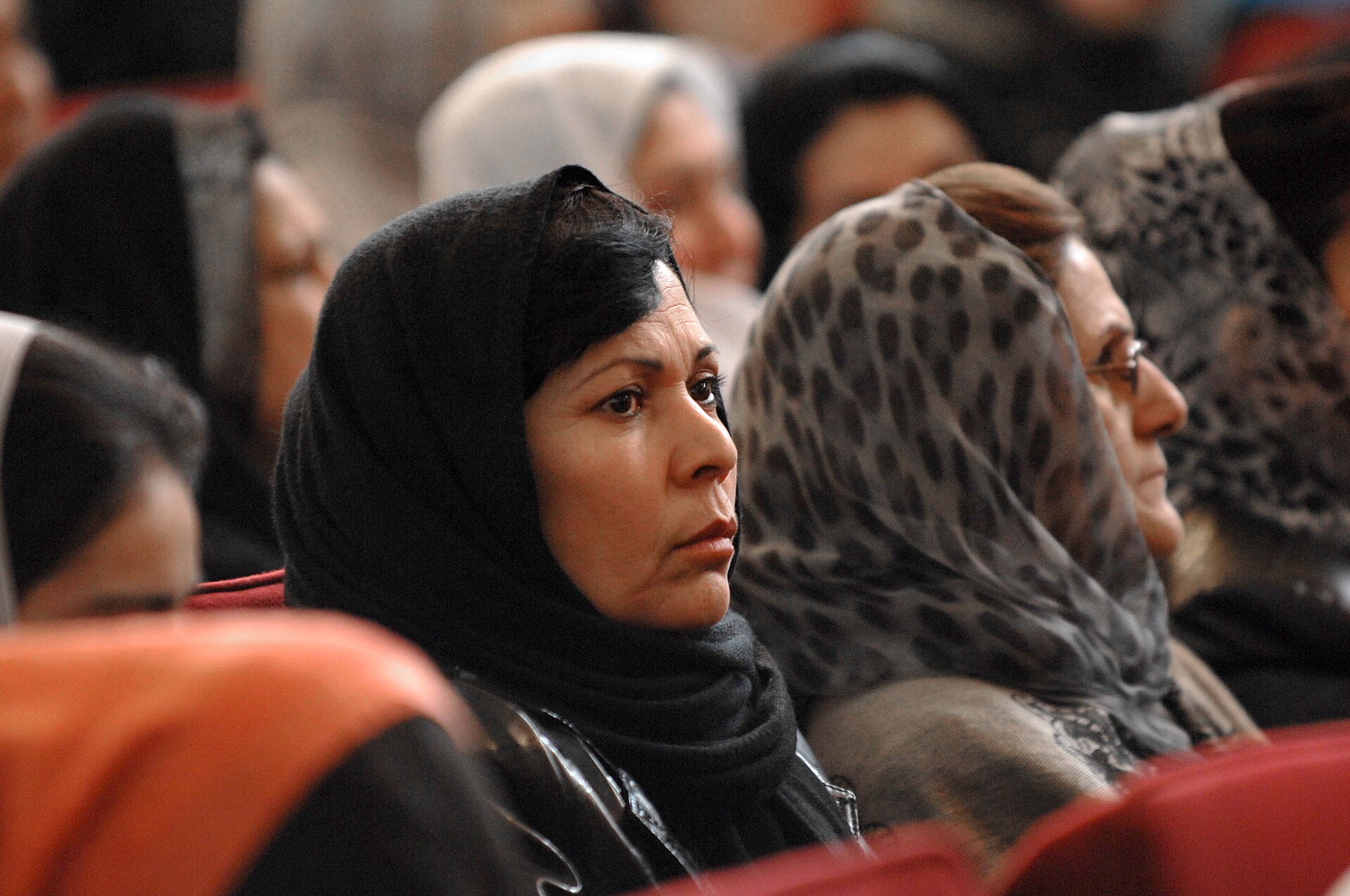
Photo: An Afghan woman listens to various speeches given during the International Women’s Day ceremony © Staff Sgt. Larry E. Reid Jr. / NATO Training Mission-Afghanistan, CC BY-SA 2.0.